AI for Resumes: I'm Breaking Ranks (And Here's Why)
Is AI ruining resumes or revolutionising them? I'm in the "it's a tool, use it wisely" camp. In this article, I share how to use AI to write your resume ethically; training it on your 'voice', fact-checking everything, and staying true to yourself. Plus, see what happens when AI writes in the voice of Jack Sparrow, Bane, or Shakespeare.
ENTREPRENEURIAL MINDSETCAREER EDUCATIONARTIFICIAL INTELLIGENCECAREER CHANGERESUMES
AI for Resumes: I'm Breaking Ranks (And Here's Why)
If you've been job searching recently, you've likely heard this:
"Don't use AI to write your resume."
I respectfully disagree. Based on my work with clients, here's why I think AI can be valuable — and how to approach it responsibly.
The "Don't Use AI" Camp — I Hear You
I understand where this advice is coming from. There are genuine concerns about AI-generated resumes that are generic, robotic, factually inflated, or so keyword-stuffed they make a recruiter's eyes glaze over before they've reached the second bullet point. Those concerns are valid.
But throwing the baby out with the bathwater? That's not helpful to people who are staring at a blank document, paralysed by the pressure of representing their entire career on two pages. Writer's block is real. Self-promotion is genuinely difficult for many people; particularly those who were raised to let their work speak for itself (it doesn't always), people who speak English as a second language, or those with learning differences who absolutely know their strengths but find it hard to translate them into words.
Here's What I Actually Think
AI is a tool. A very powerful one. Used well, it can help you:
Break through the block. When you can't find the words, AI gives you a starting point.
Tailor your resume to different roles and industries without starting from scratch every time.
Strengthen your language, replacing vague phrases like 'responsible for' with strong, active verbs and measurable outcomes.
Optimise for Applicant Tracking Systems (ATS) by incorporating relevant keywords from job descriptions.
Format and structure your document professionally, even if design isn't your strength.
The CICA Professional Standards for Australian Career Development Practitioners (2026) explicitly recognise the role of generative AI tools in supporting clients to "generate job application materials" and "navigate emerging digital tools such as AI-powered resume builders." The Standards make clear that practitioners should support clients in navigating these tools as part of best practice.
But — And This Is a Big But
AI is not a shortcut. It is not a replacement for you.
Your resume must be:
Truthful. Everything in it must be factually accurate. No inflated titles, no roles you didn't actually perform, no skills you can't back up in an interview.
Authentically yours. The voice, the tone, the way you describe your work — it should sound like you. Recruiters and hiring managers are increasingly savvy; they can spot a resume that sounds like it was written by a well-meaning algorithm.
Ethically produced. Do not include other people's or businesses' identifiable information in your AI prompts. Request placeholders, for example, [Company Name] or [Manager's Name], and fill those in yourself afterwards.
Fact-checked by you. AI can and does hallucinate. It may rephrase your experience in ways that technically sound good but misrepresent what you actually did. Read every line critically.
This is not quick work. A well-crafted, AI-assisted resume can still take several hours of thoughtful prompting, reviewing, revising, and refining. Anyone who tells you AI can do it in five minutes is setting you up to fail.
How to Make AI Sound Like You
This is the step most people skip, and it's the most important one.
Before you ask AI to write a single word of your resume, train it on your voice. Here's how:
Feed it samples of your own writing. Old emails, performance reviews you've written, LinkedIn posts, a personal statement, anything in your own words. Ask the AI to analyse your tone and writing style.
Give it a style brief. Tell it whether you're formal or conversational, whether you use Australian English (yes, that matters, 'recognise' not 'recognize,' 'programme' not 'program'), and what industries or sectors you've worked in.
Iterate and correct. If a draft doesn't sound like you, say so. 'This is too formal' or 'I wouldn't use that phrase — try again' are completely valid prompts. Keep going until the output feels like something you would actually say.
Use it as a collaborator, not a ghostwriter. Think of AI as a very patient writing partner who has read every resume ever written. You bring the story; AI helps you tell it better.
The Ethics Bit (Non-Negotiable)
As a CDAA-registered practitioner operating under CICA's Code of Ethics, I'm obligated to be transparent about this: using AI ethically means taking full responsibility for the content it produces on your behalf.
The Standards are clear: career development practitioners must "maintain professional judgment when using AI-generated outputs" and "ensure clients are informed of the ethical risks and benefits associated with digital tools, including data use, privacy, and content accuracy."
The same logic applies to you as the author of your own resume:
Do not fabricate experience. If AI suggests an achievement you didn't actually accomplish, delete it — full stop.
Do not paste identifying information (real company names, real people's names, confidential project details) into AI tools. Use placeholders and add the real information locally.
Own your document. When you submit a resume, you are representing it as a true account of your experience. That responsibility is yours, not the AI's.
For a Little Fun 🎭
To prove a point about voice and authenticity, here's the same resume paragraph, the same professional experience, the same facts, written in nine completely different voices. The content is identical. The voice is everything.
The Scenario:
A project manager describing their experience leading a team to deliver a product launch.
1. Standard AI Voice
(What it sounds like without personalisation)
Led a cross-functional team of eight professionals to deliver a successful product launch within scope, on schedule, and under budget. Collaborated with stakeholders across marketing, operations, and technology to align deliverables with strategic objectives. Demonstrated strong leadership and communication skills, resulting in a 23% increase in customer engagement within the first quarter post-launch.
Technically correct. Professionally sound. Completely forgettable. Could be anyone.
2. Mr. Peabody
(The distinguished, time-travelling genius dog — WABAC machine engaged)
Having employed the WABAC machine to review the full historical context of this project, I determined — with the assistance of my boy Sherman — that a cross-functional team of eight was precisely the optimal configuration for this particular epoch of product development. I directed proceedings with characteristic intellectual rigour, navigating stakeholder complexity across marketing, operations, and technology, and achieved a 23% uplift in customer engagement — a result which I have already cross-referenced against similar outcomes from the 1962 Brussels World's Fair. Quite satisfactory, all things considered.
3. Hannibal Lecter
(Cultured. Deliberate. Disturbingly precise.)
I led a team of eight, each selected with considerable care. The project demanded precision — the sort that comes not from instruction, but from understanding the anatomy of a good outcome. I found the stakeholders across marketing, operations, and technology to be... interesting. Some more so than others. The launch was delivered on time, under budget, and with a 23% increase in customer engagement. I do so enjoy it when things come together exactly as planned. Shall I describe the process in greater detail? I find it... stimulating.
Note: We do not recommend this approach for your actual resume.
4. Captain Jack Sparrow
(Swashbuckling, tangential, and somehow successful)
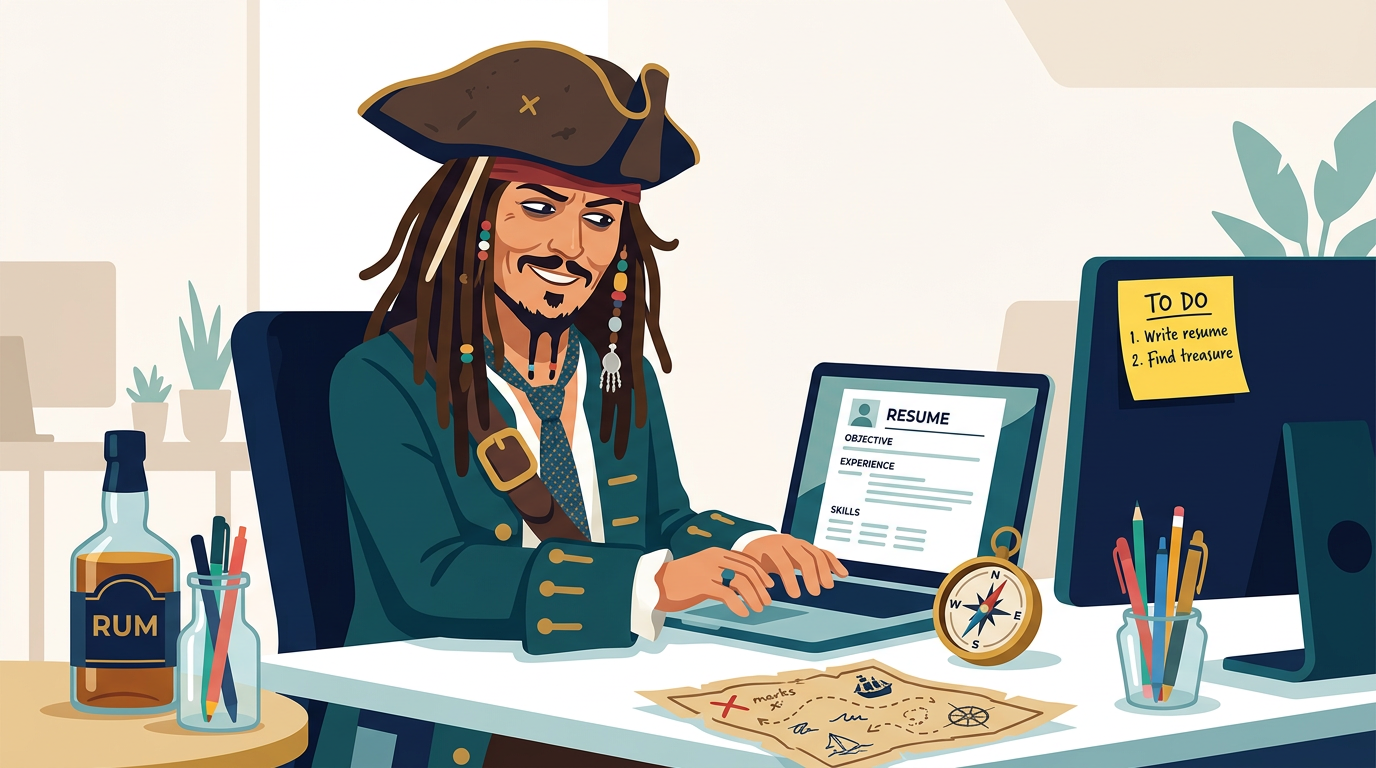
Right, so — and this is the honest truth, mostly — I found meself in charge of eight people, which, admittedly, was not entirely planned. But there was a product launch on the horizon, and someone had to steer the ship. Did I consult with marketing, operations, and technology? I did. Did they always agree with me methods? They did not. And yet — and this is the important part — we delivered on time, under budget, and with a 23% increase in customer engagement. How? Well. That's a longer story. Involves a compass that doesn't point north and a very confused stakeholder from procurement. But we got there. Savvy?
5. Bane (Tom Hardy)
(Gravelly, theatrical, absolutely menacing)
You think the project would simply deliver itself. That is the sort of thinking that leads to missed deadlines and budget overruns. I assumed control of a team of eight. I studied the stakeholders — marketing, operations, technology — each one a piece of a larger design. They came to understand that the launch was not a goal. It was inevitable. Delivered on schedule. Under budget. A 23% increase in customer engagement. When the product launched, the chaos was contained. You merely adopted the project plan. I was born in it — moulded by it.
6. Lego Batman
(The world's greatest, most self-aware caped crusader)
Okay, so first of all — I work alone. Except for this one product launch where I led eight people because Alfred said I had to and Robin was very excited about the stakeholder meetings. We crushed it across marketing, operations, and technology. Everything was on schedule because I am Batman and I don't do late. Under budget — obviously. 23% increase in customer engagement. BOOM. No big deal. Actually it's a huge deal. I'm incredible. Alfred made a spreadsheet. It was fine. I didn't need the spreadsheet but I used it anyway because teamwork or whatever.
7. Homer Simpson
(Eloquently ordinary)
Mmmm... product launch. So I was in charge of, like, eight people — which was a lot because usually I just worry about myself — and we had to do all this stuff with marketing and technology and operations and it was a lot of meetings, which normally I hate, but Lenny said there'd be donuts so I stayed. And then the launch happened and customers really liked it — like 23% more than before! Which Marge said was impressive. I thought she was talking about something else but then she explained it and I was like 'D'oh, that was me! Woo-hoo!' So yeah. I'm pretty much a great project manager.
8. The Joker (The Dark Knight)
(Chaotic, nihilistic, uncomfortably funny)
Why so serious about the product launch? You think any of it — the timelines, the budgets, the stakeholder meetings — any of it actually matters? I led eight people. I talked to marketing. I talked to operations. I talked to technology. Nobody wanted to talk back at first — but that's okay, I can be very persuasive. The launch happened. On time. Under budget. 23% increase in customer engagement. Ha. You know what I've noticed? Nobody panics when the project is slightly over scope. But miss a delivery deadline by one day, and everyone loses their minds. Introduce a little discipline... and everything burns. I'm an agent of chaos. But a very organised one.
9. William Shakespeare
(The Bard — iambic pentameter strictly optional)
Hark! What trials doth the project manager face, when charged with guiding eight brave souls to launch! I didst confer with stakeholders most diverse — in marketing, in operations, in the realm of technology — and through such discourse, wrought alignment from the discord of competing interests. The launch, delivered true and just on time, beneath the budget set by those above, did yield a harvest rich: a 23% increase in custom and engagement, by quarter's end. 'Tis not the product, nor the plan alone, but the bonds of trust 'twixt manager and team that maketh excellence of ordinary stone. Thus endeth the first act. References available upon request.
The Moral of the Story
Did you notice? The facts were the same in every single version. Led eight people. Cross-functional team. On time, under budget. 23% increase in customer engagement.
But the voice changes everything.
Your resume needs your voice, not Bane's (tempting as that may be), and not the standard AI-generated corporate drone that sounds like every other applicant in the pile. When you invest time training your AI tool, feeding it your own writing, and iterating until the output genuinely sounds like you, you get something far more powerful: a professional document that is both strategically optimised and authentically human.
That's the goal. That's what I help clients work towards.
Where to From Here?
If you're feeling blocked about your resume, or you're not sure how to use AI ethically and effectively in your job search, I can help. At Sea Change Careers, I work with people who are ready for change, and ready to present their best, most authentic selves to the world.
Get in touch today at seachangecareers.au
This article was conceived and written by Sea Change Careers, with drafting assistance from generative AI. All content has been reviewed and verified by the author.
──────────────────────────────────────────────────────────────────────
References
Career Industry Council of Australia. (2026). Professional standards for Australian career development practitioners (5th ed.). https://www.cica.org.au
Kogod School of Business. (2025). 3 ways to use AI to build a good resume. American University. https://kogod.american.edu/news/3-ways-to-use-ai-to-build-a-good-resume
Michael Page. (2024). The pros and cons of using AI to write resumes for job seekers. https://www.michaelpage.com.au/advice/career-advice/resume-and-cover-letter-advice/pros-and-cons-using-ai-write-resumes-job-seekers
MIT Career Advising & Professional Development. (2025, June 3). AI uses for resume writing. https://capd.mit.edu/resources/ai-uses-for-resume-writing/
PennWest Career Center. (2025). Tips to use AI the right way for a resume. https://career.pennwest.edu/blog/2025/02/25/tips-to-use-ai-the-right-way-for-a-resume/
Guidance
Expert career counseling and development services available.
© 2026. All rights reserved.